Hawaii Candidates for Congress
Filing Deadline: July 2012
Primary: September 2012
If you notice that a candidate's name is missing, please notify us to add it: Send E-mail to clyde2 @live.com
Hawaii Senator Election Race
Republican Senator Candidates
Charles Djou (R)
Linda Lingle (R)
Democrat Senator Candidates
Dan Akaka (D)
Ed Case (D)
Colleen Hanabusa (D)
Mufi Hannemann (D)
Mazie Hirono (D)
Donna Mercado Kim (D)
Brian Schatz (D)
Hawaii Candidates for US Congress from HI
District 1:
Colleen Hanabusa (D)
Charles Djou (R)
District 2:
Mazie Hirono (D)
Tulsi Gabbard (D)
Mufi Hannemann (D)
Josh Green (D)
Clayton Hee (D)
Gary Hooser (D)
Brian Schatz (D)
Duke Aiona (R)
Christian Voting Guide for Voters
Conservative Congress candidates of Hawaii
Hawaii Conservative Congress
http://conservativecongress.com/states/hawaii/
Hawaii Candidates for Governor
Summary information concerning the candidates and voter info.
Hawaii votes for senate candidates in the September primary. Hawaii will be electing 2 congressman this year.
Hawaii Candidates for Senate
History of Hawaii - Information that every candidate for Senator of Hawaii
should know.
The earliest settlements in the Hawaiian Islands were made by Polynesians who traveled to Hawaii using large double-hulled canoes. They brought with them pigs, dogs, chickens, taro, sweet potatoes, coconut, banana, and sugarcane.
There are several theories regarding migration to Hawaii. The "one-migration" theory suggests a single settlement. A variation on the one-migration theory instead suggests a single, continuous settlement period. A "multiple migration" theory suggests that there was a first settlement by a group called Menehune (settlers from the Marquesas Islands), and then a second settlement by the Tahitians.
On January 18, 1778 Captain James Cook and his crew, while attempting to discover the Northwest Passage between Alaska and Asia, were surprised to find the Hawaiian islands so far north in the Pacific. He named them the "Sandwich Islands". After the discovery by Cook, other Europeans and Americans came to the Sandwich Islands. An entry was found in James Cook's log describing the natives as "riding the ocean's waves on wooden boards", which became the first written account of surfing.
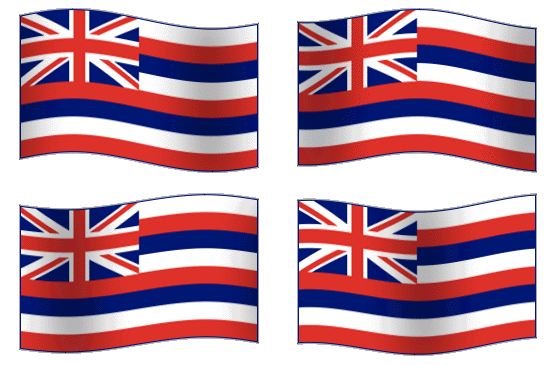
The islands were united under a single ruler, Kamehameha I, for the first time in 1810 with the help of foreign weapons and advisors. The monarchy then adopted a flag similar to the one used today by the State of Hawaii present flag, with the Union Flag in the canton (top quarter next to the flagpole) and eight horizontal stripes (alternating white, red, blue, from the top), representing the eight major islands of Hawaii.
In May 1819, Prince Liholiho became King Kamehameha II. Under pressure from his co-regent and stepmother, Kaʻahumanu, he abolished the kapu system that had ruled life in the islands. He signaled this revolutionary change by sitting down to eat with Kaʻahumanu and other women of chiefly rank, thus violating kapu by eating with a woman, an act forbidden under the old religious system - see ʻAi Noa. Kekuaokalani, a cousin who thought he was to share power with Liholiho, organized supporters of the kapu system, but his forces were defeated by Kaʻahumanu and Liholiho in December 1819 at the battle of Kuamoʻo.
|